FRB
Note: This specification is currently in an experimental and validation phase.
What is FRB?
FRB (Fishing Rod Benchmark) is
a proposed common metric and measurement framework
for capturing and comparing fishing rod “sensitivity” as vibration.
Traditionally, “sensitivity” has been described as human experience:
- bite detection
- environmental awareness
- lure control
FRB introduces a different perspective:
Sensitivity is redefined as a structure of vibration.
Background
Rod sensitivity has historically been described using vague terms such as:
- high sensitivity
- low sensitivity
- rich information
However,
even when people say “high sensitivity,”
the actual experience differs from person to person.
A Shift in Perspective
In the PC world, storage performance is evaluated using metrics such as:
- Sequential Read
- Sequential Write
- IOPS (random access performance)
In contrast, in the fishing rod world,
only subjective expressions exist:
- “sensitive”
- “not sensitive”
FRB introduces a new idea:
to measure sensitivity itself.
In other words,
FRB transforms
experienced sensation into a measurable phenomenon.
Relationship to SSD Benchmarking
FRB applies the concept of performance benchmarking to fishing rods.
| Category | FRB | Target User | SSD Benchmark | Target User |
|---|---|---|---|---|
| Phase 1 | Surface Response (frequency-based score) | Beginners | Sequential (Read / Write) | General users |
| Phase 2 | Simulated Bite Response | Intermediate+ | IOPS (I/O per second) | Advanced users |
Definition
In FRB,
Sensitivity = characteristics of vibration
FRB Architecture
A structural overview of FRB:
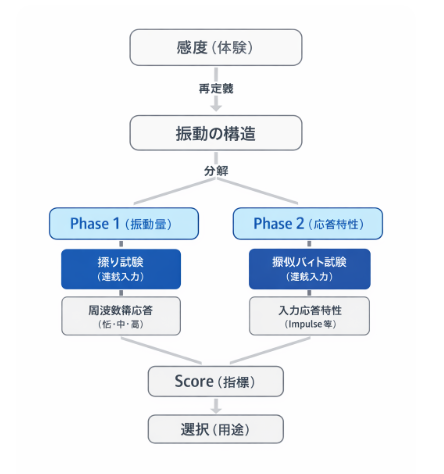
Relationship to Traditional “Sensitivity”
Traditional classifications:
- Bite sensitivity
- Environmental sensitivity
- Operational sensitivity
These are all based on human perception.
FRB redefines them as vibration structures:
- Bite sensitivity → Input Response (Phase 2)
- Environmental sensitivity → Low–Mid frequency response (Phase 1)
- Operational sensitivity → Frequency + Input response (Phase 1 + Phase 2)
FRB decomposes and reconstructs
the ambiguous concept of sensitivity.
Measurement Targets
FRB focuses on:
- vibration magnitude
- frequency characteristics
- transmission characteristics
These represent
what humans are actually perceiving.
Phase Structure (Draft Definition)
FRB separates:
- evaluation (Score)
- input (Test)
Phase 1 (Fundamental Metrics)
Overview
Continuous contact input generates vibration,
allowing evaluation of
vibration characteristics (magnitude and frequency)
Phase1 Score
Evaluates vibration magnitude and frequency distribution:
“How much vibration is present”
Example:
:::note info Phase1 Score (Surface Response)
J: 99 (Carpet: low-frequency response)
F: 85 (Flooring: mid-frequency response)
S: 72 (Stainless: high-frequency response)
:::
Phase1 Input (Test)
Vibration is generated by rubbing the rod against materials.
This method is called:
FRB Surface Response Test
Phase 2 (Applied Metrics)
Overview
Input is defined as changes in tension along the line,
evaluating the rod’s
response characteristics (transmission and perception)
Phase2 Score
Evaluates transmission efficiency and response characteristics:
“How the rod responds to changes in load”
Fish bites, physically, are changes in force:
- instantaneous impact (Impulse)
- sustained pull (Suction)
- interference (Weed)
All of these can be observed as
changes in line tension (load variation).
Example:
:::note info FRB Phase2 Score (Simulated Bite Response)
Impulse: 92 (impact response)
Suction: 78 (pull-in response)
Weed: 65 (interference response)
:::
Phase2 Input (Test)
Simulated load changes equivalent to fish bites are applied
to the rod under controlled conditions.
This method is called:
FRB Phase2 Bite Simulator
(e.g., rubber bands, springs, controlled tension release)
Input methods are currently under validation.
Design Philosophy
FRB is based on the following principles:
Scalability and Simplicity
Each phase is limited to:
- maximum 3 evaluation metrics
While allowing expansion through additional phases.
- 1 phase = up to 3 metrics
- phases = extendable
Complexity is absorbed by structure,
while keeping interpretation simple.
FRB is not designed for evaluation,
but for selection.
Reproducibility
FRB prioritizes not absolute precision, but:
reproducibility under consistent conditions
- executable indoors
- no specialized equipment required
- comparable under controlled conditions
Key Point
FRB does NOT measure catch results.
It measures:
the structure of what is being perceived.
Vision
Instead of saying:
“This rod is sensitive”
we aim to say:
“This rod has these vibration characteristics”
Current Status
This definition is still in the draft stage.
However, at least one thing can be stated:
Rod differences can be captured
as vibration.
(Next)
Why has rod sensitivity never been quantified? — FRB Motivation
FRB is not a metric for evaluation,
but a metric designed for selection.
Revision History
- 2026-03-14 : 初版